What Is Simcenter 3D Electromagnetics? Low-Frequency Electromagnetic Simulation

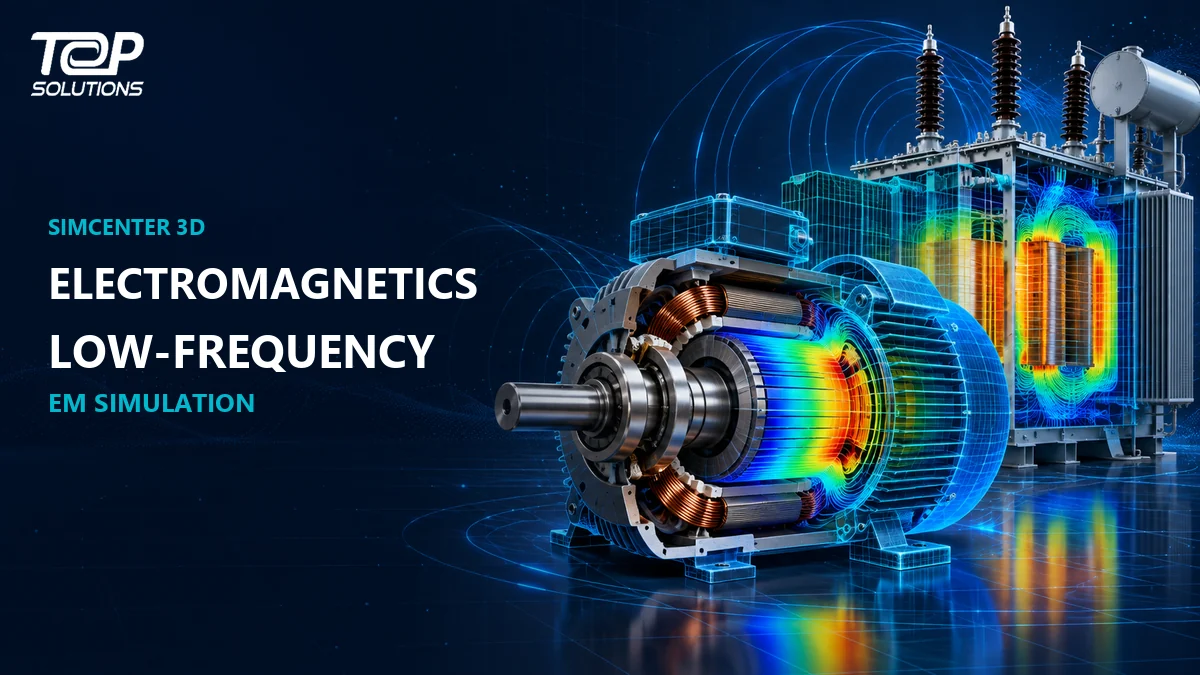
Developing an electric motor, transformer, inductor or other electromagnetic device requires more than evaluating mechanical geometry.
Magnetic-field distribution affects torque and efficiency. Eddy currents generate losses and heat. Temperature changes influence resistance and material behavior. Electromagnetic forces can also excite structures and contribute to vibration and noise.
For this reason, electromagnetic simulation is increasingly connected with thermal, structural and NVH engineering.
Simcenter 3D Low Frequency Electromagnetics provides low-frequency electromagnetic simulation capabilities within the multidisciplinary Simcenter 3D environment.
It enables engineering teams to evaluate electromagnetic fields, losses, forces and other quantities, then connect those results with thermal, structural, dynamics and NVH workflows when required.
For a broader view of Siemens engineering simulation technologies, explore
the Top Solutions and Simcenter engineering portfolio.
What is Simcenter 3D Low Frequency Electromagnetics?
Simcenter 3D Low Frequency Electromagnetics provides electromagnetic analysis capabilities for electrical and electromechanical devices within the Simcenter 3D CAE environment.
Engineering problems may involve:
- Magnetic fields
- Electric fields
- Current flow
- Electromagnetic losses
- Force and torque
- Motion
- Thermal behavior
- Electro-thermal coupling
A typical workflow can be represented as:
CAD Geometry → Materials → Coils / Excitations → Electromagnetic Solve → Losses & Forces → Thermal / Structural / NVH Analysis → Engineering Decision
Its value is not limited to electromagnetic field visualization.
Simulation results can be transferred into other engineering disciplines when the product needs to be evaluated as a complete multiphysics system.
What technology powers Simcenter 3D Low Frequency Electromagnetics?
The Siemens electromagnetic simulation portfolio includes several technologies for different applications.
Current low-frequency electromagnetic capabilities in Simcenter 3D build on solver technology inherited from Simcenter MAGNET.
This distinction is important because Simcenter Flux continues to exist as a separate low-frequency electromagnetic simulation product.
Simcenter 3D Low Frequency Electromagnetics should therefore not be described simply as “Flux inside Simcenter 3D.”
Both solutions address low-frequency electromagnetic engineering, but their environments, workflows and multidisciplinary integration differ.
What is low-frequency electromagnetic simulation?
Low-frequency electromagnetic simulation is commonly used for devices where magnetic fields, electric fields, current flow and material behavior determine product performance.
Important engineering quantities may include:
- Magnetic flux density
- Electric field
- Current density
- Voltage
- Flux linkage
- Torque
- Electromagnetic force
- Eddy-current losses
- Core losses
- Temperature
These results help answer practical questions.
For example:
- Does the motor generate the required torque?
- Where are electromagnetic losses concentrated?
- Are transformer hotspots developing in critical regions?
- How do eddy-current effects influence efficiency?
- Can electromagnetic forces cause vibration or noise?
- How does operating temperature change performance?
Key Simcenter 3D Electromagnetics capabilities
1. Magnetic field simulation
Magnetic-field analysis is fundamental to many low-frequency electromagnetic applications.
Engineers can evaluate flux distribution in:
- Electric motors
- Transformers
- Inductors
- Electromagnetic actuators
- Coils
- Electromechanical devices
Field visualization helps identify saturation, leakage flux and areas where magnetic behavior may require design changes.
2. Static, AC and transient electromagnetic analysis
Electromagnetic devices operate under different conditions.
Depending on the application, teams may need to evaluate:
- Static behavior
- Steady-state AC
- Time-harmonic response
- Transient electromagnetic behavior
Transient analysis becomes especially important when current, motion or magnetic state changes over time.
3. Electric machine simulation
Electric-machine development is a major application for low-frequency electromagnetic analysis.
Engineering teams can investigate:
- Magnetic flux
- Torque
- Torque ripple
- Electromagnetic losses
- Current distribution
- Efficiency
- Electromagnetic forces
These results can also support thermal and NVH simulation.
This creates a more complete view of motor behavior than electromagnetic performance alone.
4. Transformer simulation
Transformer development requires engineers to understand electromagnetic losses, heating and force-related effects.
Simulation can support evaluation of:
- Magnetic flux
- Core losses
- Winding losses
- Stray losses
- Current distribution
- Short-circuit forces
- Thermal behavior
Field and loss visualization can reveal areas that may become hotspots before physical testing.
5. Inductor and coil simulation
Inductors and coil-based devices must balance electromagnetic performance, physical size, losses and temperature.
Engineers can evaluate:
- Flux paths
- Inductance
- Current density
- Core saturation
- Losses
- Thermal behavior
These applications are relevant to power electronics, charging systems and many electromechanical products.
6. Electromagnetic force and torque
Force and torque connect electromagnetic and mechanical engineering.
Torque is a direct performance metric for electric motors.
In transformers and actuators, electromagnetic forces can also produce deformation, vibration and noise.
Transferring force distributions into structural simulation allows engineering teams to evaluate both the electromagnetic source and the mechanical response.
7. Electro-thermal simulation
Electromagnetic losses generate heat.
Temperature then changes resistance and material properties.
This creates an important multiphysics interaction:
Electromagnetic Losses → Heat Generation → Temperature Distribution → Updated Performance
Electro-thermal analysis helps engineers evaluate operating conditions more realistically than assuming constant temperature.
8. Electromagnetic NVH
Electric-machine NVH is not driven only by bearings or mechanical imbalance.
Electromagnetic forces can excite the structure and generate vibration and noise.
A connected workflow may follow:
Electromagnetic Forces → Structural Response → Vibration → Acoustic Radiation
This makes it easier to understand the source of a noise problem rather than evaluating only the final acoustic result.
Why use Simcenter 3D for multiphysics electromagnetic simulation?
Simcenter 3D provides a multidisciplinary CAE environment.
Low-frequency electromagnetic results can be connected with:
- Thermal simulation
- Structural analysis
- Dynamics
- NVH
- Optimization
This is particularly useful for electric motors and transformers.
A motor workflow, for example, may include:
- Calculate electromagnetic torque and losses
- Transfer losses into a thermal model
- Predict operating temperature
- Evaluate temperature-dependent performance
- Transfer electromagnetic forces into an NVH workflow
- Review efficiency, temperature and noise together
Such a workflow provides a more complete engineering picture than optimizing every discipline independently.
Where is Simcenter 3D Electromagnetics used?
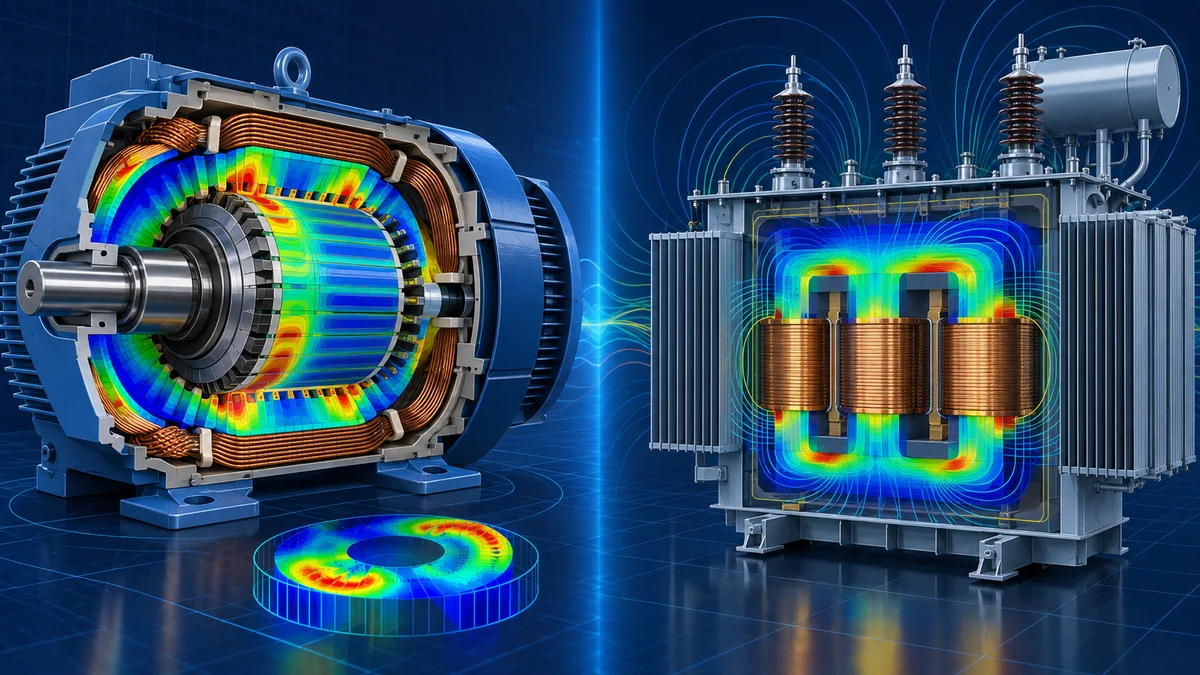
Electric vehicles and e-mobility
Electrification makes electric-machine performance central to vehicle development.
Applications may include:
- Traction motors
- E-drive systems
- Auxiliary motors
- Electromagnetic efficiency
- Thermal performance
- Electromagnetic NVH
Industrial motors
Industrial motors need to balance torque, efficiency, temperature and reliability.
Low-frequency electromagnetic simulation enables engineers to investigate design alternatives before committing to physical prototypes.
Transformers
Transformer simulation may focus on:
- Core loss
- Winding loss
- Stray loss
- Thermal hotspots
- Electromagnetic force
- Vibration and hum
Power electronics
Inductors, busbars and other electromagnetic components can be evaluated for field distribution, losses and thermal behavior.
Actuators and electromechanical devices
For actuators, electromagnetic force and motion may be direct performance targets.
Simulation helps engineers understand those quantities before physical prototyping.
Simcenter 3D Electromagnetics vs. Feko vs. Flux
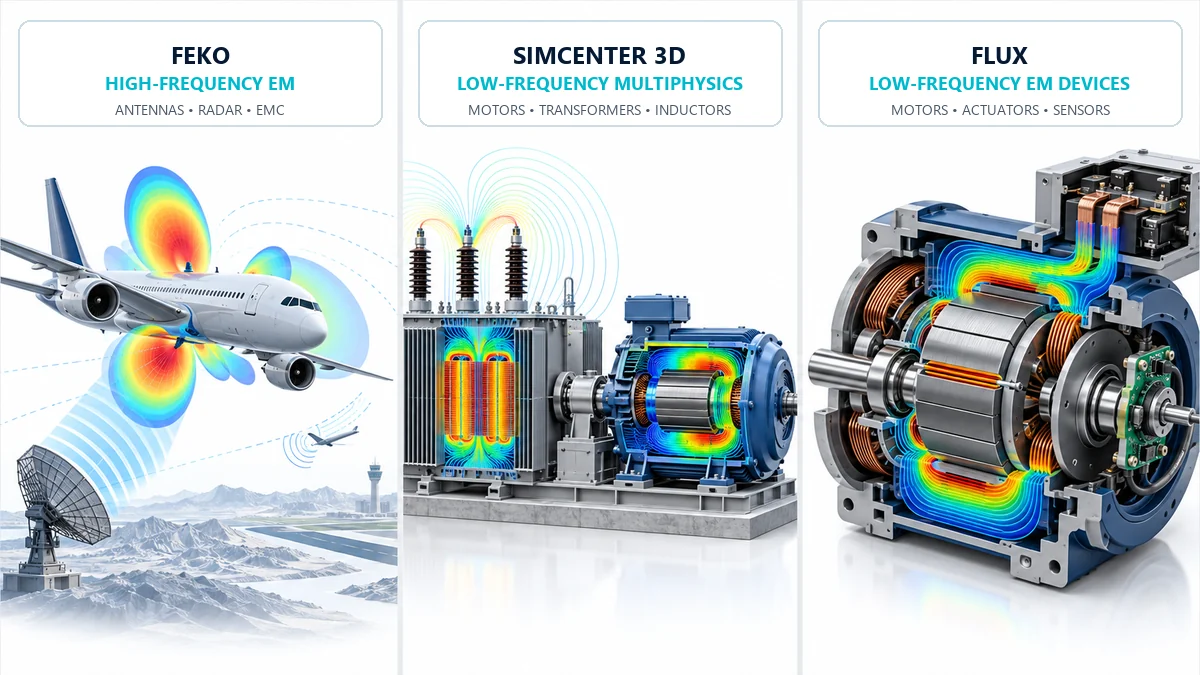
| Solution | Primary focus | Typical applications |
|---|---|---|
| Simcenter Feko | High-frequency electromagnetics | Antennas, RF, EMC/EMI, radar and RCS |
| Simcenter 3D Low Frequency EM | Low-frequency electromagnetics in a multidisciplinary CAE environment | Electric machines, transformers, inductors, electro-thermal and EM-NVH |
| Simcenter Flux | Dedicated low-frequency electromagnetic device simulation | Motors, sensors, actuators, transformers and power devices |
The most fundamental distinction is that Feko addresses high-frequency applications, while Simcenter 3D Low Frequency EM and Flux focus on low-frequency electromagnetic devices.
Simcenter 3D is particularly relevant when electromagnetic analysis must connect closely with broader CAE disciplines.
Flux provides a dedicated electromagnetic environment for detailed low-frequency device development.
Simcenter 3D Electromagnetics vs. Simcenter Flux
Both technologies address low-frequency electromagnetics, but their workflows differ.
Simcenter 3D Low Frequency Electromagnetics operates within Simcenter 3D and is well suited to multidisciplinary workflows involving structural, thermal or NVH simulation.
Simcenter Flux is a dedicated low-frequency electromagnetic simulation solution for motors, transformers, actuators, sensors and power devices.
Selection should therefore consider:
- Device type
- Required multiphysics coupling
- Existing CAD and CAE workflow
- Solver requirements
- Automation
- Optimization
- Thermal coupling
- NVH requirements
Does Simcenter 3D Electromagnetics replace Simcenter Feko?
No.
The products address different electromagnetic regimes.
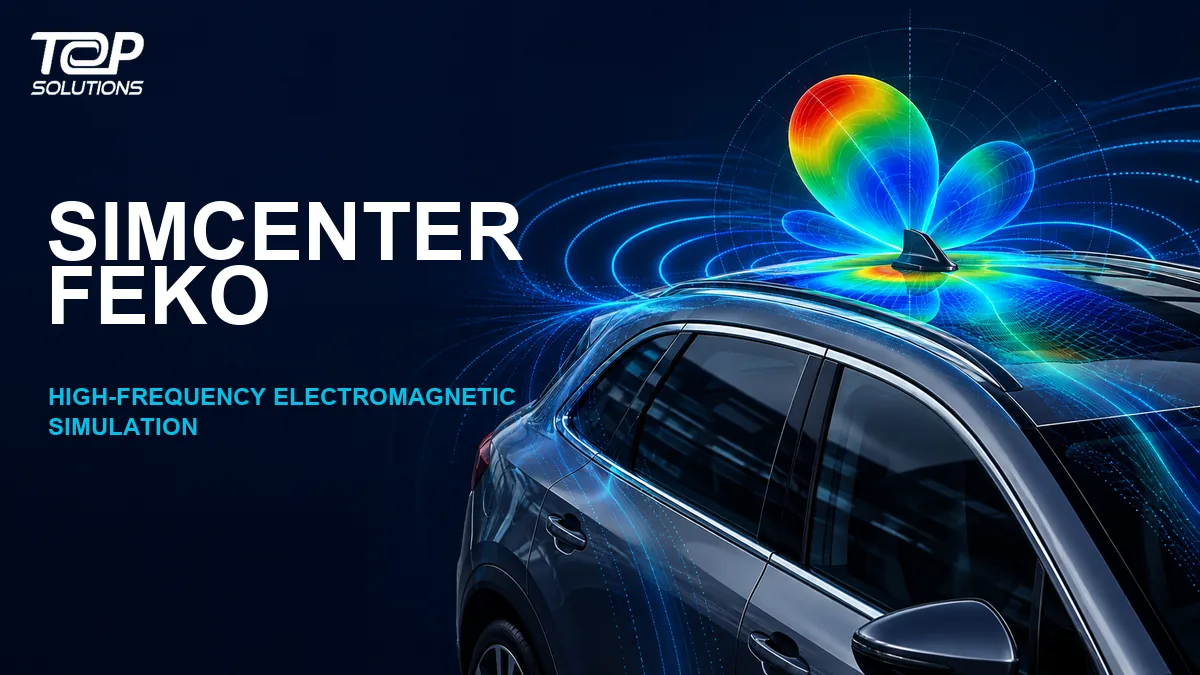
Simcenter Feko focuses on high-frequency electromagnetic wave behavior for antennas, RF, radar and EMC.
Simcenter 3D Low Frequency Electromagnetics focuses on low-frequency fields and electromagnetic devices such as motors and transformers.
An automotive antenna and an electric traction motor both involve electromagnetics, but their physics and numerical requirements differ significantly.
A practical low-frequency electromagnetic simulation workflow
The process should begin with the engineering KPI.
1. Define objectives
Examples include:
- Torque
- Efficiency
- Core losses
- Winding losses
- Temperature
- Electromagnetic force
- NVH
2. Prepare geometry
The model should preserve features relevant to electromagnetic behavior without unnecessary complexity.
3. Assign materials
Magnetic, electrical and thermal properties need to represent real operating materials.
4. Define coils, circuits and excitations
Electrical inputs should reflect the intended operating condition.
5. Select the analysis type
The engineering team determines whether static, AC or transient simulation is appropriate.
6. Solve the electromagnetic model
Field quantities, current, forces, torque and losses are calculated.
7. Connect multiphysics models
Losses can drive thermal analysis, while force distributions can support structural or NVH simulation.
8. Validate results
Predictions should be compared with reliable measurements or established baselines whenever available.
Automation and design exploration
Electric machines and electromagnetic devices may contain many design variables.
Examples include:
- Airgap
- Magnet dimensions
- Winding configuration
- Core geometry
- Materials
- Operating current
- Cooling conditions
Automation allows engineering teams to investigate a larger design space without rebuilding the model manually for every configuration.
Electromagnetic models can also be connected with optimization technologies to evaluate trade-offs between multiple performance targets.
AI-assisted electromagnetic simulation
Another emerging workflow uses high-fidelity simulation data to train surrogate models.
Instead of running a full electromagnetic analysis at every operating point, suitable predictive models may provide rapid estimates for some design-exploration and system-level tasks.
Potential applications include:
- Design exploration
- System simulation
- Rapid prediction
- Optimization
AI does not remove the need for electromagnetic simulation.
Its value comes from combining high-fidelity physics-based data with faster predictive models where appropriate.
Who should evaluate Simcenter 3D Electromagnetics?
The solution may deserve evaluation when an organization:
- Develops electric motors or electric machines
- Designs transformers or inductors
- Needs electromagnetic loss prediction
- Requires electro-thermal simulation
- Needs electromagnetic force input for NVH
- Wants a connected multidisciplinary CAE workflow
- Wants to reduce physical prototype iterations
- Needs to evaluate many design alternatives
Typical users may include:
- Electromagnetic engineers
- Electric-machine engineers
- Motor-design engineers
- CAE engineers
- Thermal engineers
- NVH engineers
- R&D engineers
- Engineering managers
How should a company evaluate the solution?
A Proof of Concept should use representative company data.
A practical evaluation may include:
- Select a motor, transformer or electromagnetic device
- Define engineering KPIs
- Prepare geometry and material data
- Define operating conditions
- Build the electromagnetic model
- Compare predictions with measurement or baseline data
- Evaluate losses, force and temperature
- Test multiphysics workflows if required
- Review simulation turnaround time
- Assess automation and deployment potential
The key question is:
Does the solution provide sufficiently reliable engineering information and fit the organization’s existing development workflow?
Simcenter 3D Electromagnetics consulting in Vietnam
Top Solutions provides CAD/CAM/CAE/PLM solutions and supports engineering teams implementing Simcenter technologies based on real technical requirements.
Companies evaluating low-frequency electromagnetic simulation can discuss:
- Electric-machine simulation
- Transformer analysis
- Inductor simulation
- Electromagnetic losses
- Electro-thermal analysis
- Electromagnetic NVH
- Multiphysics workflows
- Computing requirements
- Licensing
- Training
- Proof-of-Concept projects
Evaluating an electric motor, transformer or low-frequency electromagnetic device?
Frequently asked questions about Simcenter 3D Electromagnetics
What is Simcenter 3D Low Frequency Electromagnetics?
It is a set of low-frequency electromagnetic simulation capabilities within Simcenter 3D for electric machines, transformers, inductors and related multidisciplinary engineering workflows.
Does Simcenter 3D Electromagnetics use Flux technology?
It should not be described that way. Current low-frequency electromagnetic capabilities in Simcenter 3D build on technology inherited from Simcenter MAGNET. Simcenter Flux remains a separate product in the Siemens electromagnetic portfolio.
Can Simcenter 3D simulate electric motors?
Yes. Applications include magnetic-field prediction, torque, electromagnetic losses, forces and connected thermal or NVH workflows.
Can Simcenter 3D simulate transformers?
Yes. Low-frequency electromagnetic capabilities support transformer-related field, loss, force and electro-thermal studies.
What is the difference between Simcenter 3D Electromagnetics and Feko?
Feko focuses on high-frequency applications such as antennas, radar and EMC, while Simcenter 3D Low Frequency EM focuses on electric machines, transformers, inductors and low-frequency devices.
What is the difference between Simcenter 3D Electromagnetics and Flux?
Simcenter 3D emphasizes multidisciplinary CAE integration, while Flux is a dedicated low-frequency electromagnetic simulation environment for motors, sensors, actuators, transformers and power devices.
Can electromagnetic losses be coupled with thermal simulation?
Yes. Electromagnetic losses can be used as heat-generation inputs to evaluate operating temperature and electro-thermal performance.
How should a company begin evaluating the software?
A representative Proof of Concept based on an actual motor, transformer or electromagnetic device provides a practical way to evaluate accuracy, workflow efficiency and multiphysics integration.
Conclusion
Simcenter 3D Low Frequency Electromagnetics brings electromagnetic analysis into a multidisciplinary CAE workflow rather than treating electromagnetics as an isolated engineering activity.
This is especially valuable for electric machines, transformers and devices in which magnetic fields, losses, temperature, electromagnetic forces and NVH interact.
The objective is not simply to calculate more field quantities.
The greater value is helping engineering teams understand overall product performance and make better design decisions before relying heavily on physical prototypes.
Explore the
Top Solutions engineering software portfolio
to discuss suitable electromagnetic and multiphysics simulation technologies.