What Is Simcenter Feko? High-Frequency Electromagnetic Simulation Software
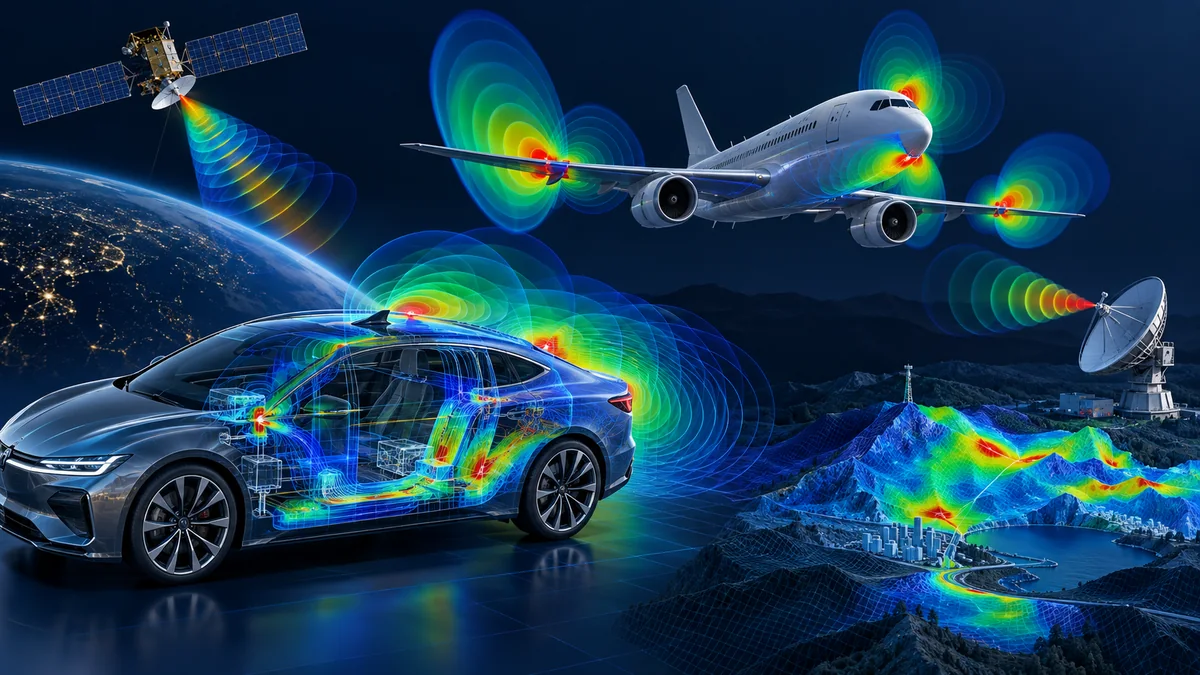
When a product depends on antennas, radar, wireless connectivity or high-frequency electronics, its performance is influenced by much more than mechanical geometry.
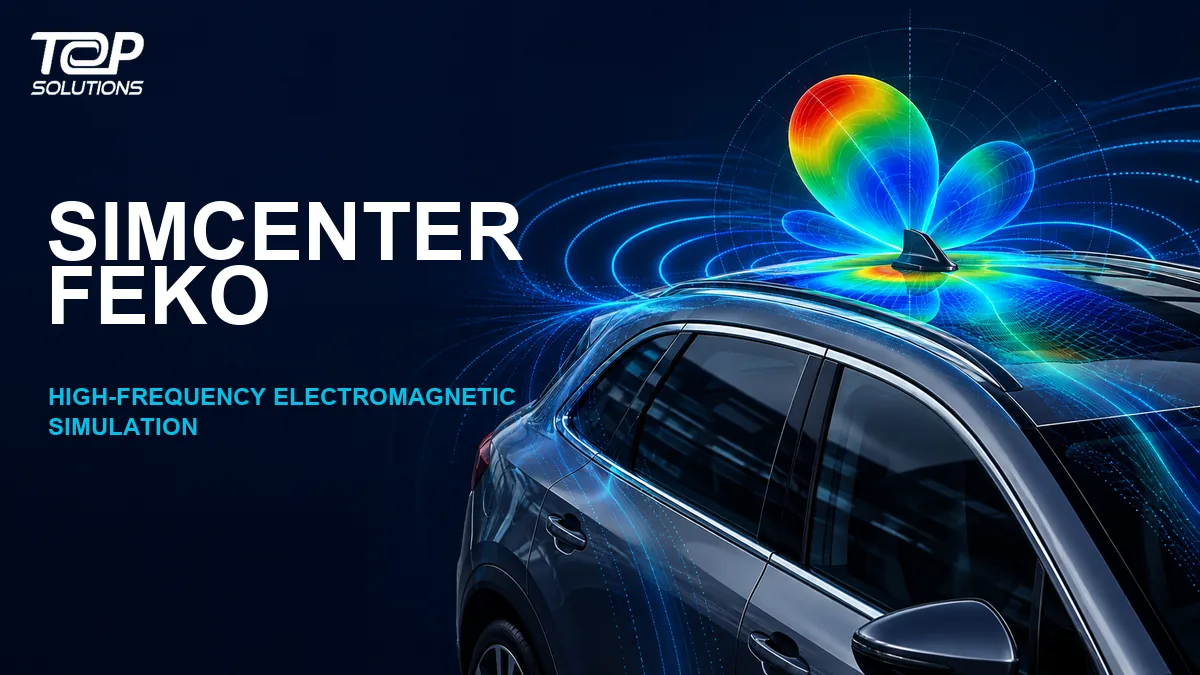
An antenna may perform well in isolation but behave differently after installation on a vehicle. Nearby structures can change its radiation pattern. Cables and electronic systems may become paths for electromagnetic interference. In radar applications, the geometry and materials of an entire platform can influence scattering behavior.
These effects are difficult to understand by reviewing individual components alone.
Simcenter Feko is Siemens’ high-frequency electromagnetic simulation software for antenna design and placement, electromagnetic compatibility, electromagnetic interference, radar, radar cross section and wireless communication applications.
It enables engineering teams to study electromagnetic performance digitally before relying entirely on physical prototypes and measurement campaigns.
For a broader view of the Siemens simulation portfolio, explore
Simcenter and the Top Solutions engineering software portfolio.
What is Simcenter Feko?
Simcenter Feko is a high-frequency electromagnetic simulation solution for predicting the behavior and interaction of electromagnetic waves.
Typical applications include:
- Antenna design
- Installed antenna performance
- Antenna placement
- Antenna coupling
- Electromagnetic compatibility
- Electromagnetic interference
- Radar systems
- Radar Cross Section
- Electromagnetic scattering
- Wireless propagation
- RF systems
- Wireless communication
A simplified workflow can be represented as:
Geometry → Materials → Sources & Excitations → EM Solver → Field / Radiation Results → Engineering Decision
The important point is that Feko is not limited to evaluating an antenna under ideal standalone conditions.
Engineers can investigate how electromagnetic performance changes when the antenna or RF system is installed within the real product environment.
What is the new name for Altair Feko?
Following the integration of Altair technologies into the Siemens portfolio, the product name changed:
Altair Feko → Simcenter Feko
Older documentation and search results may still use names such as Altair Feko or Altair FEKO.
For current technical and commercial content, Simcenter Feko should be used as the product name.
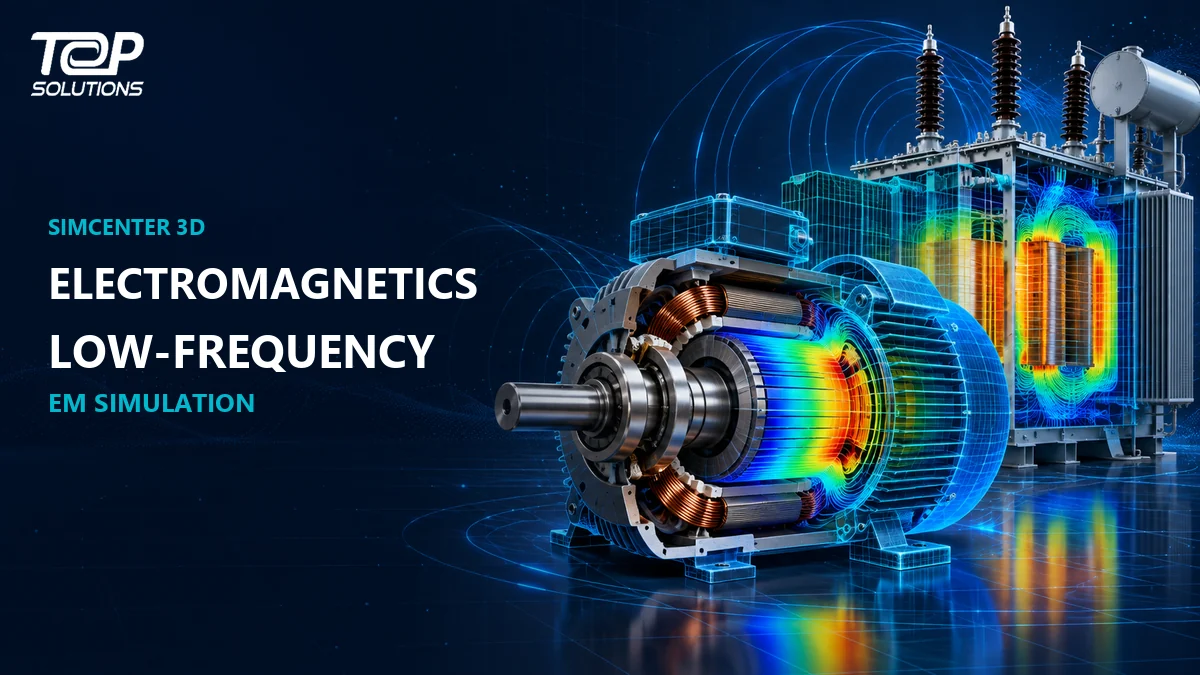
The transition also places the technology within the broader Simcenter electromagnetic simulation portfolio, alongside solutions for low-frequency electromagnetics, electric-machine design and multidisciplinary simulation.
What is high-frequency electromagnetic simulation?
At high frequencies, wavelength, geometry, source location and the surrounding environment can strongly influence electromagnetic behavior.
Engineers may need to understand:
- Antenna radiation patterns
- Gain and directivity
- Electromagnetic field distribution
- Reflection and transmission
- Coupling between antennas
- Installed antenna behavior
- Electromagnetic interference
- Scattering
- Radar Cross Section
- Wireless coverage
Simulation enables these characteristics to be investigated digitally before the complete physical system exists.
Physical measurement remains important for validation. Electromagnetic simulation complements testing by helping engineers explore design alternatives and identify potential problems earlier.
Key Simcenter Feko capabilities
1. Antenna design and analysis
Antenna simulation is one of the core applications of Simcenter Feko.
Engineering teams can investigate characteristics such as:
- Radiation pattern
- Gain
- Directivity
- Impedance
- Return loss
- Antenna coupling
- Near-field behavior
- Far-field behavior
Simulation becomes particularly valuable during design exploration, when geometry, substrate characteristics, feed position and other parameters can still be adjusted.
Instead of building a physical prototype for every possible configuration, engineers can use simulation to reduce the design space before testing selected candidates.
2. Installed antenna performance
An antenna that performs well in isolation may behave differently after installation.
Metal structures, glass, composites, housings, cables and nearby antennas can all affect electromagnetic performance.
Feko enables antenna behavior to be evaluated on platforms such as:
- Vehicles
- Aircraft
- UAVs
- Satellites
- Marine platforms
- Electronic devices
- Communication systems
The engineering challenge therefore extends beyond developing a good antenna.
Teams also need to determine where and how it should be integrated so that required performance is maintained on the final product.
3. Antenna coupling
Modern products may contain multiple antennas for cellular communication, GPS, Wi-Fi, Bluetooth, radar and other functions.
When several antennas operate in close proximity, their interaction becomes an important design consideration.
Coupling simulation can help engineers assess whether a particular layout may degrade system performance.
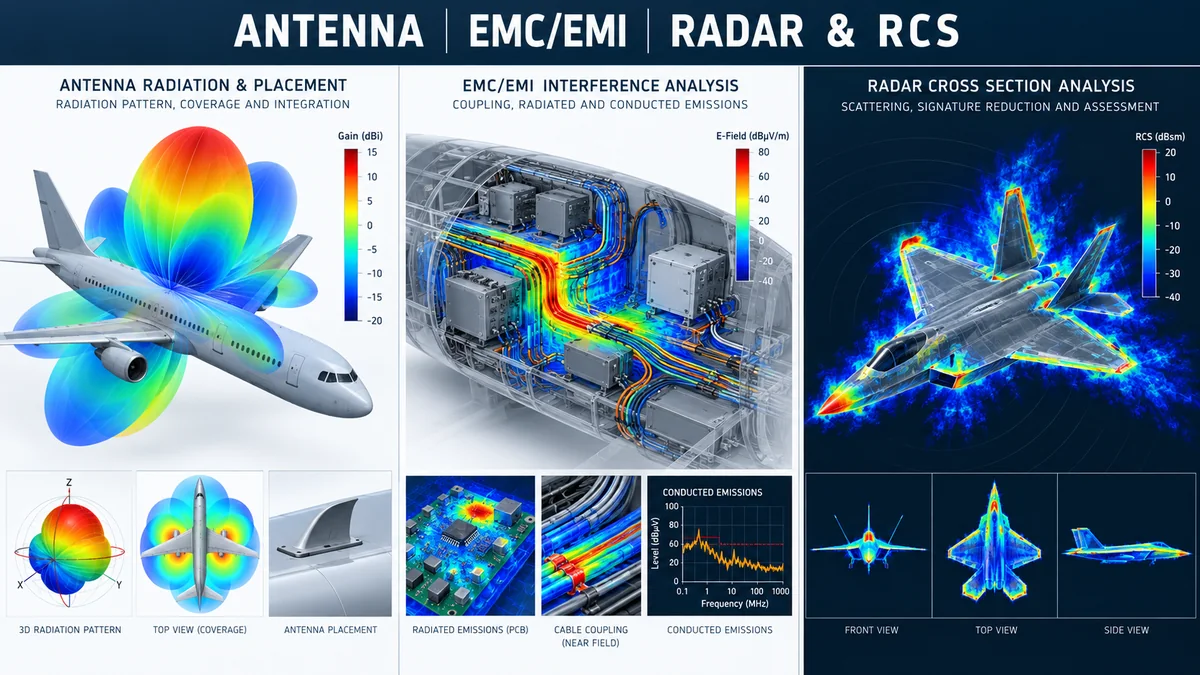
4. EMC and EMI simulation
Electromagnetic Compatibility, or EMC, concerns a product’s ability to operate correctly within its electromagnetic environment without creating unacceptable interference for other equipment.
Electromagnetic Interference, or EMI, can disturb the intended operation of electronic equipment.
Feko supports workflows related to:
- Radiated emissions
- Radiated susceptibility
- Cable coupling
- Shielding effectiveness
- Electromagnetic interaction between subsystems
Simulation can help identify potential coupling and interference paths before a complete system enters formal EMC testing.
5. Cable modeling
Cables and wiring harnesses can play an important role in electromagnetic interference.
This is particularly relevant in automotive, aerospace and electronics systems containing many interconnected devices.
Cable-related simulation can be used to study:
- Coupling into cables
- Cable radiation
- Routing effects
- Shielding
- Interaction with electromagnetic sources
6. Radar and Radar Cross Section
Simcenter Feko supports radar and electromagnetic scattering applications.
One important metric is Radar Cross Section, or RCS, which describes how strongly an object reflects radar energy under defined conditions.
Applications may include:
- Radar development
- Automotive radar
- Radome analysis
- Electromagnetic scattering
- Platform interaction
- RCS evaluation
Large radar and scattering models can place significant demands on numerical methods and computing resources, making solver selection an important part of the simulation strategy.
7. Wireless propagation and coverage
Wireless engineering extends beyond antenna design.
Engineers may also need to understand how a signal propagates through the operating environment.
Simulation can help investigate:
- Coverage
- Signal strength
- Propagation paths
- Interference
- Environmental effects
Applications can range from individual products to buildings and wider communication environments.
8. 5G and wireless communication systems
Higher-frequency communication systems place greater emphasis on antenna placement, propagation and interaction with surrounding structures.
Simulation allows teams to investigate alternative configurations before committing to hardware or deployment decisions.
Why does hybrid solver technology matter?
No single numerical method is ideal for every electromagnetic problem.
A compact antenna, a cable network and an aircraft platform can differ dramatically in electrical size, geometry and simulation requirements.
Simcenter Feko provides multiple numerical techniques for full-wave and high-frequency electromagnetic analysis.
The ability to combine solver technologies is particularly useful for electrically large or multi-scale systems.
Instead of forcing every part of a model to use the same numerical approach, engineers can apply methods suited to different parts of the problem.
This can help balance computational efficiency and required simulation fidelity.
Where is Simcenter Feko used?
Automotive
Modern vehicles contain an increasing number of RF and wireless systems.
Typical applications include:
- Antenna placement
- Vehicle connectivity
- Automotive radar
- EMC and EMI
- Antenna coupling
- Wireless performance
The growth of electrification and power electronics also increases the need to consider electromagnetic compatibility at vehicle level.
Aerospace and defense
Aircraft and defense platforms combine electrically large structures with demanding antenna and radar requirements.
Applications can include:
- Installed antenna performance
- Radar
- Radar Cross Section
- Radomes
- Satellite communication
- Antenna placement
- Electromagnetic scattering
Telecommunications
Feko can support antenna development, wireless communication, propagation and coverage studies.
These workflows are useful when teams need to evaluate both antenna characteristics and signal behavior in the surrounding environment.
Electronics
As connected electronic devices become more densely integrated, EMC and EMI become increasingly important design considerations.
Simulation can reveal potential interactions before complete prototypes enter measurement and compliance testing.
Industrial systems
Wireless sensors, antennas and RF systems are increasingly common in industrial equipment.
Engineering problems may include connectivity, interference, enclosure shielding and wireless coverage within industrial facilities.
A practical Simcenter Feko workflow
An electromagnetic simulation project should begin with the engineering question, not the solver button.
1. Define the target quantity
Examples include:
- Antenna gain
- Radiation pattern
- Return loss
- Coupling
- Field strength
- Radar Cross Section
- Coverage
- Shielding effectiveness
2. Prepare the geometry
The model should contain details that materially affect electromagnetic behavior without becoming unnecessarily complex.
3. Define materials
Material properties influence how electromagnetic fields interact with structures.
4. Define sources and excitations
The excitation should represent the system or engineering scenario being investigated.
5. Select the numerical approach
Solver strategy should reflect electrical size, geometry, frequency range and the required result.
6. Run the simulation
Computational time is not the only consideration. Engineers also need to confirm that the model and numerical approach are appropriate for the intended use.
7. Evaluate results
Results may include fields, currents, radiation patterns, antenna gain, coupling or Radar Cross Section depending on the application.
8. Validate the model
Where suitable measurement data or a trusted baseline exists, predictions should be compared against it before the model is used broadly for engineering decisions.
Simcenter Feko vs. Simcenter Flux
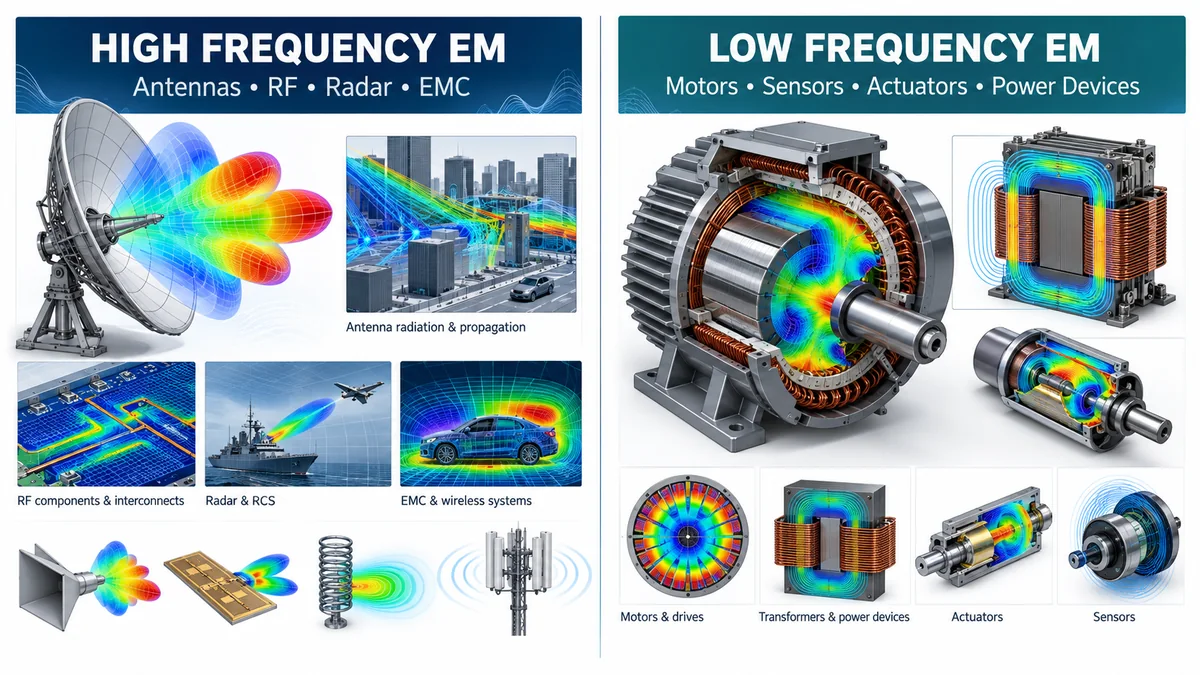
Feko and Flux address different areas of electromagnetic engineering.
| Area | Simcenter Feko | Simcenter Flux |
|---|---|---|
| Primary focus | High-frequency electromagnetics | Low-frequency electromagnetics |
| Typical applications | Antennas, RF, EMC/EMI, radar, RCS and wireless systems | Motors, actuators, sensors, transformers and power devices |
| Typical physical behavior | Wave propagation and high-frequency field interaction | Low-frequency magnetic and electric field behavior |
| Example | Vehicle antenna or radar simulation | Electric motor or actuator simulation |
They should therefore not be treated as two competing tools for exactly the same engineering problem.
The correct solution depends on the electromagnetic regime and device being analyzed.
How does Feko fit into the broader Simcenter workflow?
A real product rarely involves only one physics domain.
An aerospace antenna, for example, may need to satisfy electromagnetic performance requirements while also surviving vibration, mechanical loads and extreme temperatures.
A broader simulation process may therefore combine electromagnetic analysis with structural, thermal or other engineering disciplines.
This is an important reason to evaluate Feko within the complete Simcenter portfolio rather than as an isolated electromagnetic tool.
Automation and design exploration
Antenna performance can depend on many design parameters:
- Geometry dimensions
- Feed location
- Substrate properties
- Antenna spacing
- Installation position
- Operating frequency
Simulation workflows can be automated to evaluate multiple design configurations instead of adjusting every variable manually.
This becomes useful when engineers need to balance several KPIs.
One design may deliver stronger gain but unacceptable coupling. Another may improve bandwidth while becoming difficult to integrate into the platform.
Design exploration helps teams understand such trade-offs before committing to hardware.
Who should evaluate Simcenter Feko?
Simcenter Feko may deserve evaluation when a company:
- Develops antennas or RF systems
- Needs to evaluate installed antenna performance
- Uses several antennas on one product
- Faces EMC or EMI challenges
- Develops radar or automotive radar systems
- Needs Radar Cross Section analysis
- Develops wireless communication systems
- Needs propagation or coverage analysis
- Wants to reduce early physical prototype iterations
Potential users include:
- RF engineers
- Antenna engineers
- EMC engineers
- Electromagnetic simulation engineers
- Radar engineers
- CAE engineers
- R&D engineers
- Technical managers
How should a company evaluate Simcenter Feko?
A Proof of Concept based on a representative engineering problem provides more useful evidence than a generic demonstration.
A practical evaluation may include:
- Select an antenna, radar or EMC problem
- Define the required engineering KPIs
- Prepare geometry and material data
- Define the frequency range and excitation
- Identify available measurement data or a baseline
- Create the simulation model
- Compare simulation predictions with reference data
- Explore several design variables
- Review computational turnaround time
- Assess automation and scaling potential
The objective is not simply to prove that the software has many capabilities.
It is to answer a practical question:
Can Simcenter Feko solve the company’s electromagnetic engineering problem with an appropriate level of fidelity, turnaround time and workflow efficiency?
Simcenter Feko consulting in Vietnam
Top Solutions supports manufacturing and engineering organizations with CAD/CAM/CAE/PLM software, consulting and implementation services.
Companies evaluating Simcenter Feko can discuss requirements related to:
- Antenna design
- Antenna placement
- EMC and EMI
- Radar and RCS
- RF and wireless systems
- Frequency range
- Model scale
- Computing requirements
- Existing simulation workflows
- Software licensing
- User training
- Proof-of-Concept projects
Evaluating an antenna, EMC, radar or high-frequency electromagnetic problem?
Frequently asked questions about Simcenter Feko
What is Simcenter Feko?
Simcenter Feko is Siemens’ high-frequency electromagnetic simulation software for antenna design, EMC/EMI, radar, Radar Cross Section, RF and wireless communication applications.
What is the new name for Altair Feko?
Altair Feko has been renamed Simcenter Feko as Altair technologies are integrated into the Siemens Simcenter portfolio.
Can Simcenter Feko simulate antennas?
Yes. Antenna design, radiation analysis, installed antenna performance, antenna placement and antenna coupling are important Simcenter Feko applications.
Does Simcenter Feko support EMC and EMI simulation?
Yes. Feko supports electromagnetic compatibility and interference workflows including coupling, shielding and cable-related electromagnetic analysis.
Can Feko be used for radar simulation?
Yes. Simcenter Feko supports radar-related electromagnetic analysis, scattering and Radar Cross Section evaluation.
What is the difference between Simcenter Feko and Simcenter Flux?
Simcenter Feko focuses primarily on high-frequency applications such as antennas, RF, radar and EMC. Simcenter Flux focuses on low-frequency electromagnetic applications such as motors, actuators, sensors and power devices.
Is Simcenter Feko used in automotive engineering?
Yes. Automotive applications include vehicle antenna placement, connectivity, EMC/EMI, automotive radar and interaction among multiple wireless systems.
How should a company start evaluating Simcenter Feko?
A practical approach is to select a representative antenna, EMC or radar problem, define measurable engineering KPIs and baseline data, and conduct a Proof of Concept before broader deployment.
Conclusion
Simcenter Feko enables engineering teams to investigate electromagnetic behavior before the complete physical product exists.
Its value extends beyond simulating an isolated antenna.
Engineers can study antennas, radar, EMC/EMI and wireless performance in the context of realistic product environments and understand how surrounding structures influence the final system.
As products incorporate more connectivity, electronics and sensing technologies, electromagnetic performance needs to be considered earlier in development rather than discovered only during final testing.
Simulation does not eliminate measurement.
It helps teams identify issues earlier, evaluate more design options and use physical testing more effectively.
Explore the
Top Solutions engineering software portfolio
to discuss suitable simulation technologies for your application.