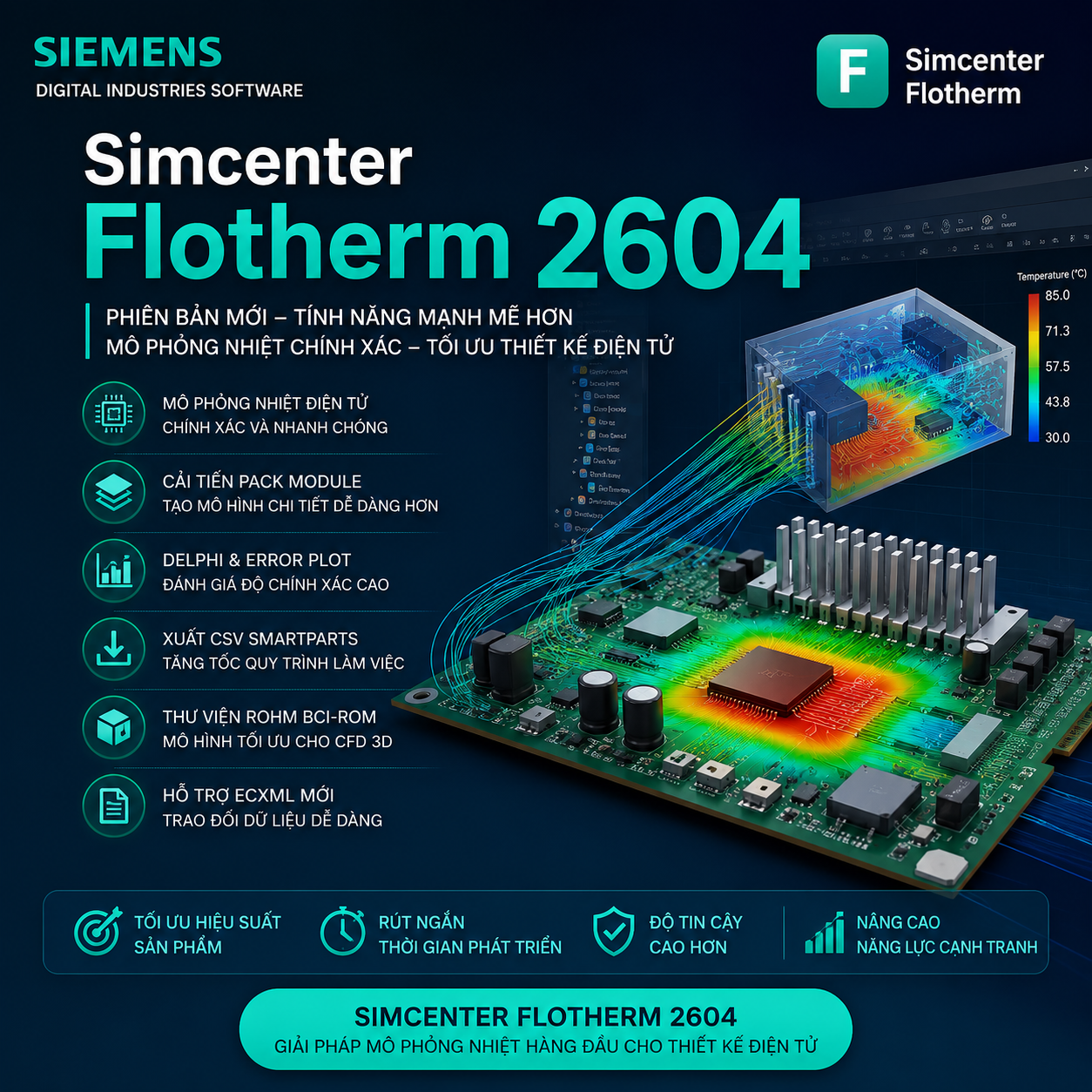
Simcenter Flotherm 2604 is Siemens’ thermal simulation software release for electronics cooling and package-level analysis. This update adds faster workflows for compact thermal model development, DELPHI validation, component data reuse, and model exchange through ECXML.
🔹 Simcenter Flotherm 2604 Enables Simulation of More Complex Systems
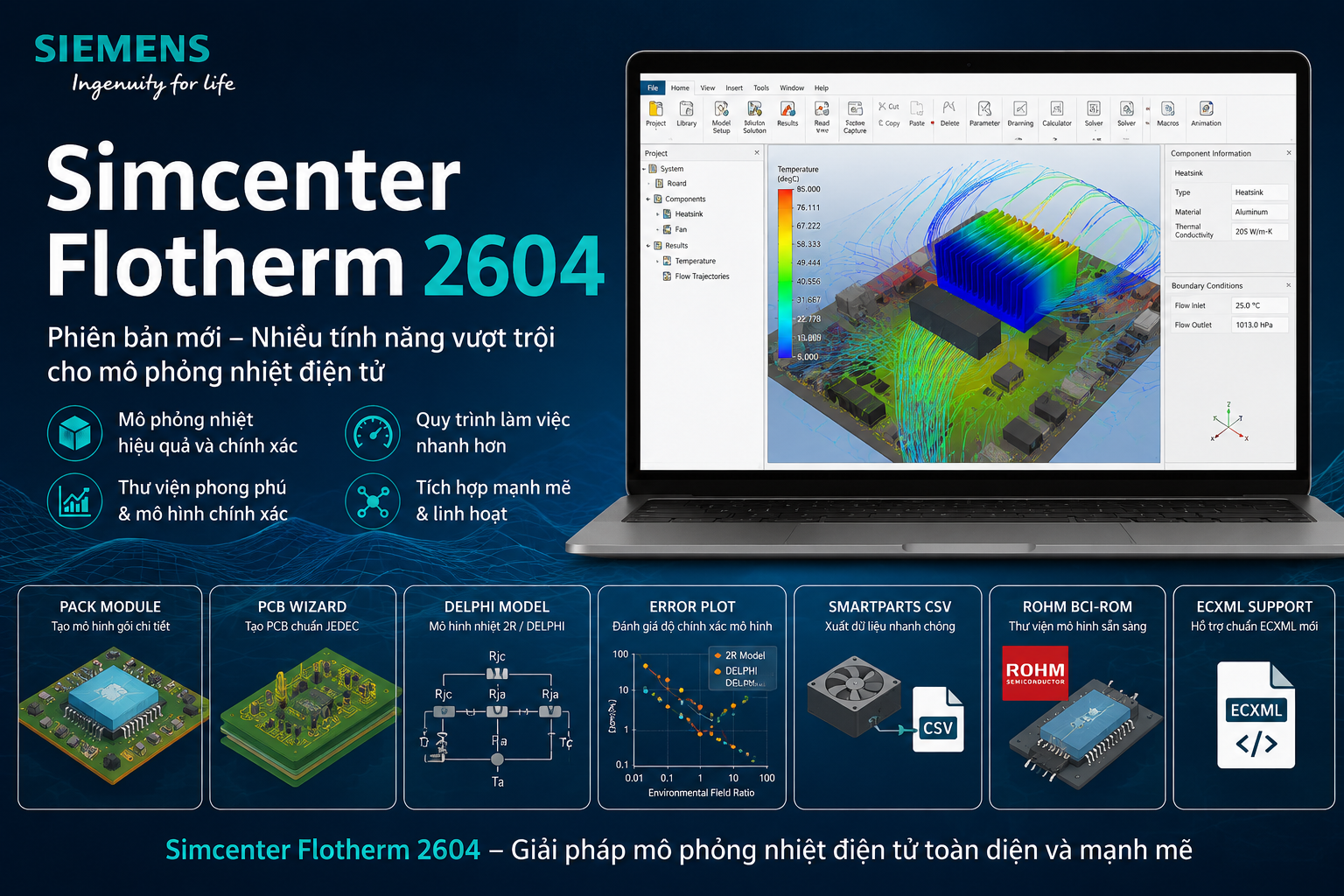
Enhancements to Simcenter Flotherm Pack Module
Simcenter Flotherm 2604 introduces further enhancements to the Simcenter Flotherm Pack Module, a capability first introduced in version 2504 to support the creation of detailed thermal models for single-die packages through a template-based workflow fully integrated into the Simcenter Flotherm environment.
Users can create detailed package models within the module and generate 2-Resistor (2R) and DELPHI compact thermal models using the Simcenter Flotherm Command Center.
Key enhancements to the Pack Module in Simcenter Flotherm 2604 include:
a) New PCB Template
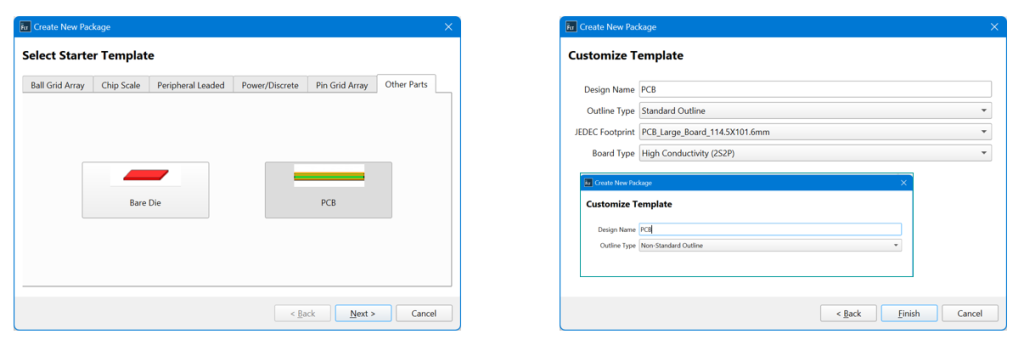
In Simcenter Flotherm 2604, Siemens has introduced a new PCB template that enables users to quickly create JEDEC-standard boards without having to configure them manually.
The new PCB template is available under the Other Objects tab in the package creation window.
The wizard enables users to easily generate JEDEC-standard test boards with different configurations, including:
- Large or small board sizes
- 4-layer boards for high thermal conductivity or 1-layer boards for low thermal conductivity
These boards can be created directly within the Simcenter Flotherm Pack Module, simplifying the setup of package-level thermal characterization models.
b) Customizable DELPHI Models for Advanced Applications
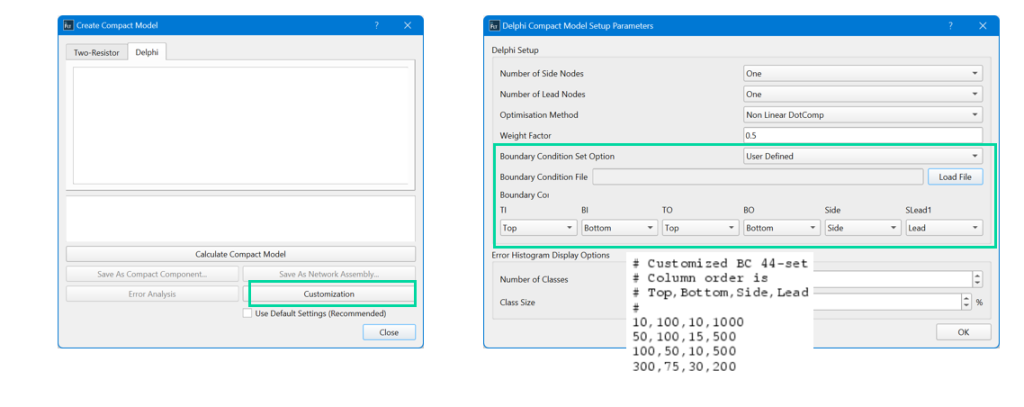
Users can now customize DELPHI settings for more advanced thermal simulation applications, including the ability to import boundary-condition definitions from CSV files.
Available customization options include:
- Number of side nodes, up to two
- For peripheral leaded packages, the number of lead nodes: 1, 2, or 4
- Optimization method and fitting parameters
Users can also import predefined sets of boundary conditions from a CSV file.
Each row represents an individual simulation scenario, with heat transfer coefficient values in W/m²K provided in comma-separated format.
After importing the file and selecting the required boundary-condition set, users can map individual data columns to the corresponding surface nodes of either the compact thermal model or the detailed model.
This provides greater flexibility when developing compact thermal models for complex package-level thermal analysis.
c) New Error Plot for DELPHI Models
Another notable enhancement in Simcenter Flotherm 2604 is improved support for evaluating customized DELPHI models used in advanced electronics thermal simulation.
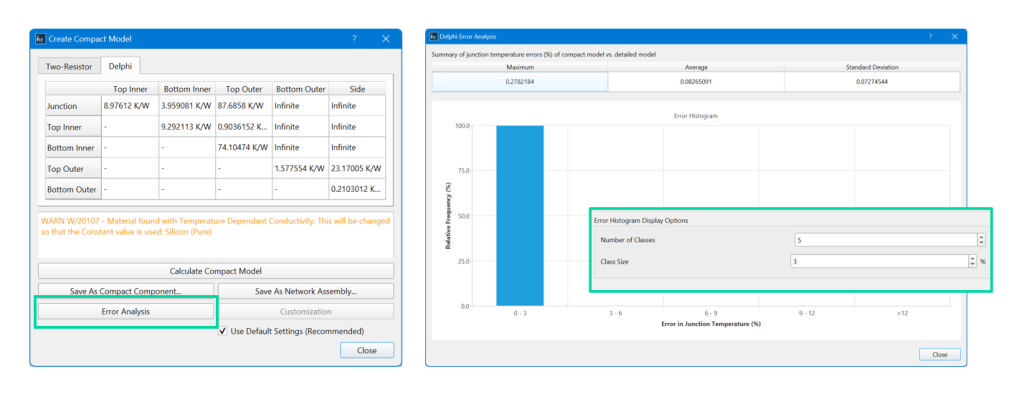
Simcenter Flotherm 2604 introduces a new Error Plot that helps users evaluate the accuracy of DELPHI compact thermal models.
Once all simulation scenarios have been completed and the DELPHI model has been generated, the plot displays:
- Errors obtained from the compact-model backfitting process
- The percentage of the environmental range associated with each error interval
This visualization enables engineers to quickly assess model quality and determine how accurately the compact thermal model represents the detailed thermal model across different boundary conditions.
🔹 Simcenter Flotherm 2604 Accelerates Engineering Workflows
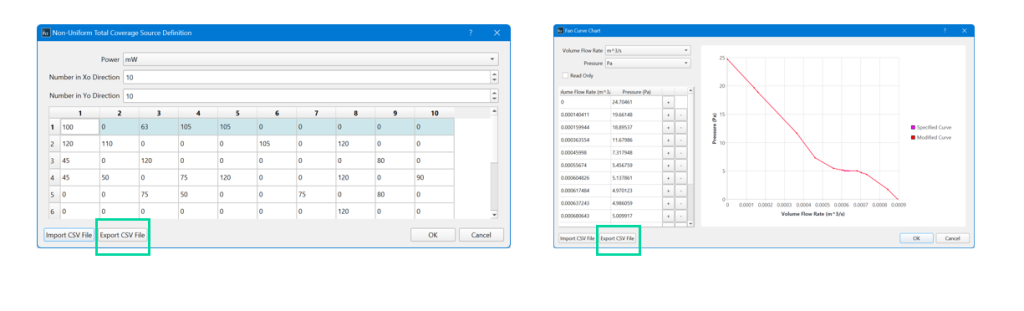
In Simcenter Flotherm 2604, SmartPart data can be exported directly to CSV format, making it easier to edit, manage, and reuse component information.
Die and fan SmartParts are commonly used in electronics cooling models. To simplify data modification and reuse, Siemens has added CSV data export capabilities for these SmartParts.
Improved Model Property Visualization
Users can also identify model associations more efficiently.
They can:
- Right-click a property name
- Select Show Attached Objects
This enables all objects associated with the selected property to be highlighted directly within the model view, improving navigation and project management when working with large or complex thermal models.
🔹 Enhanced Connectivity and Expanded Model Libraries
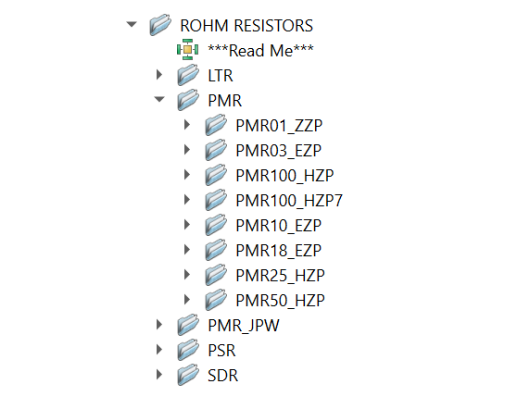
Simcenter Flotherm 2604 includes a new library of BCI-ROM models from ROHM Semiconductor, helping engineers reduce model preparation time while improving the accuracy and efficiency of electronics thermal simulation.
New Embeddable BCI-ROM Library from ROHM Semiconductor
ROHM Semiconductor has expanded the library with additional embeddable BCI-ROM models for shunt resistors.
These models are:
- Optimized for thermal simulation
- Suitable for integration into 3D CFD models
- Validated against measurement data
The models are included directly with the Simcenter Flotherm 2604 installation.
Engineers can therefore incorporate these models directly into board- and system-level thermal simulations without requiring an additional BCI-ROM module, unless they need to automatically generate new BCI-ROM models themselves.
This approach can significantly reduce model development effort when analyzing electronics containing supported ROHM components.
Enhanced ECXML Support
Another new capability in Simcenter Flotherm 2604 is expanded support for the ECXML standard, including:
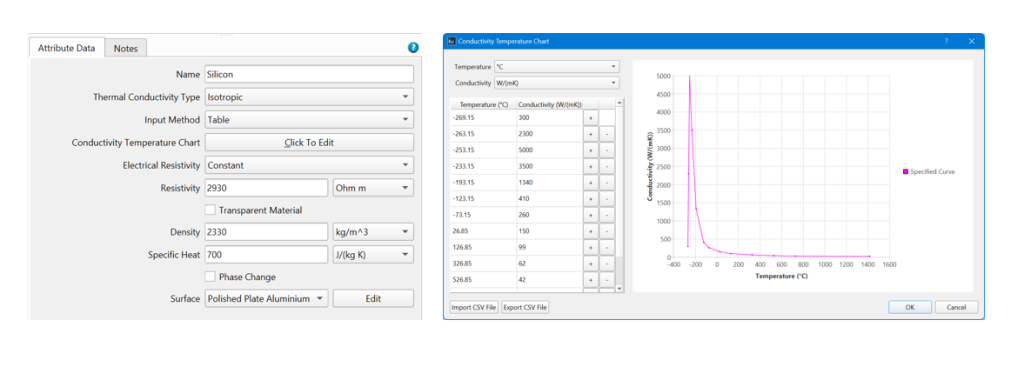
- Piecewise-linear isotropic thermal conductivity
This enhancement enables more accurate representation of materials whose thermal conductivity varies with temperature.
ECXML – Electronics Cooling eXtensible Markup Language – is a neutral data format developed through JEDEC to support the exchange of electronics thermal models between simulation applications such as:
- Simcenter Flotherm
- Simcenter FLOEFD
Simcenter Flotherm 2604 also provides warnings when users attempt to export geometry that is not supported by the ECXML format, helping engineers identify potential interoperability issues before transferring models between applications.
Simcenter Flotherm 2604 delivers significant enhancements for electronics thermal simulation, covering the Pack Module, SmartParts, DELPHI compact thermal models, ROHM Semiconductor BCI-ROM libraries, and ECXML interoperability.
These improvements help engineering organizations shorten model development time, improve simulation accuracy, streamline thermal engineering workflows, and increase the efficiency of electronic product development.
For organizations currently using earlier versions, Simcenter Flotherm 2604 provides a valuable upgrade path for taking advantage of the latest capabilities in electronics cooling and thermal simulation.